
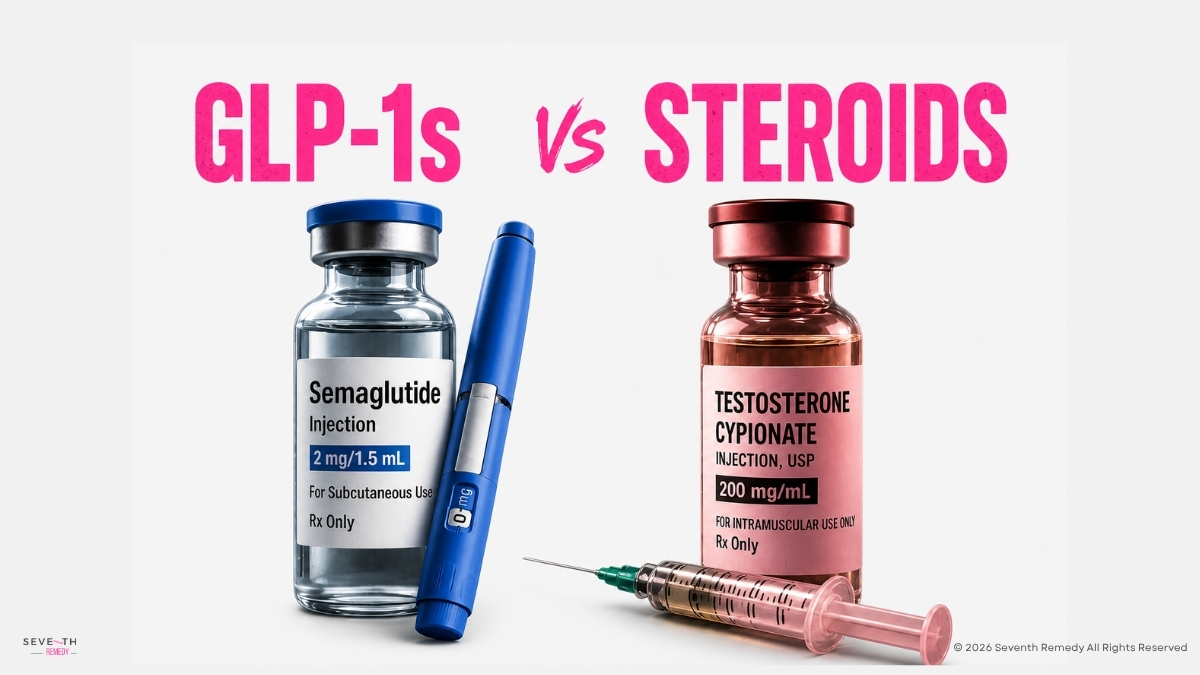
The fitness industry can be incredibly motivating, supportive, and life-changing. I’ve built my career in it because I genuinely believe movement, strength, and better health can change people’s lives. But like any space, it also has its flaws, and this is one of the biggest ones I keep noticing.
The moment I mention that I work with women using GLP-1 medications, I can sometimes feel the shift in the conversation. The reactions change, and the assumptions start. What stands out to me is how differently fitness culture responds to certain kinds of help.
A man can use anabolic steroids to build more muscle, recover faster, and push his physique beyond what training alone would normally allow, and many people will still describe him as dedicated, disciplined, or serious about fitness. But when a woman uses a GLP-1 medication to treat obesity, insulin resistance, or type 2 diabetes, the conversation often turns into cheating, shortcuts, laziness, or taking the easy way out.
That disconnect says a lot, and I don’t think it’s only about the medication itself. I think it reveals who fitness culture respects for getting help, who it questions for it, and how differently we view performance enhancement for aesthetics versus medical treatment for obesity and metabolic disease.
Anabolic steroids have existed in gym culture for decades, long before GLP-1 medications became widely used for obesity treatment. Still, GLP-1 use is constantly criticized in a way that feels hard to ignore once you start really noticing it.
Why Muscle Enhancement Gets Treated Differently
When you look at the numbers by gender, there is a pretty obvious pattern. Anabolic steroid use in gym and bodybuilding spaces is much higher in men1,2, while GLP-1 and similar weight loss medications are used more often by women3.
I think that exposes a bias that has existed in fitness culture for a long time. Muscle is treated as something earned through effort, while body weight is treated as something controlled through willpower.
Bigger, leaner, more muscular bodies (often associated with males) are admired. People look the other way or stay quiet about enhancement. Steroids usually get a pass on the “shortcut” label because everyone knows they don’t work without intense training, and there’s still this belief that the person is putting in the work, even if they’re using something to directly shift the outcome.
Larger bodies or weight struggles (more often associated with females) are judged. People question the method used to lose weight, the amount of effort used, and whether it was really earned.
What gets missed is that GLP-1 use still requires major lifestyle changes for many people. I see women learning how to eat differently, strength train consistently, manage protein intake, regulate stress, and navigate a body that can feel unfamiliar from one moment to the next. Sometimes this is all happening while also dealing with the changes that come with peri/menopause. That is physical work, mental work, and emotional work, too.
At the core of it, both situations involve someone using a tool to change an outcome, yet the reaction is often completely different. We are comfortable with people using assistance when it moves them toward a body we admire, but we question it when it challenges what we believe about personal responsibility.
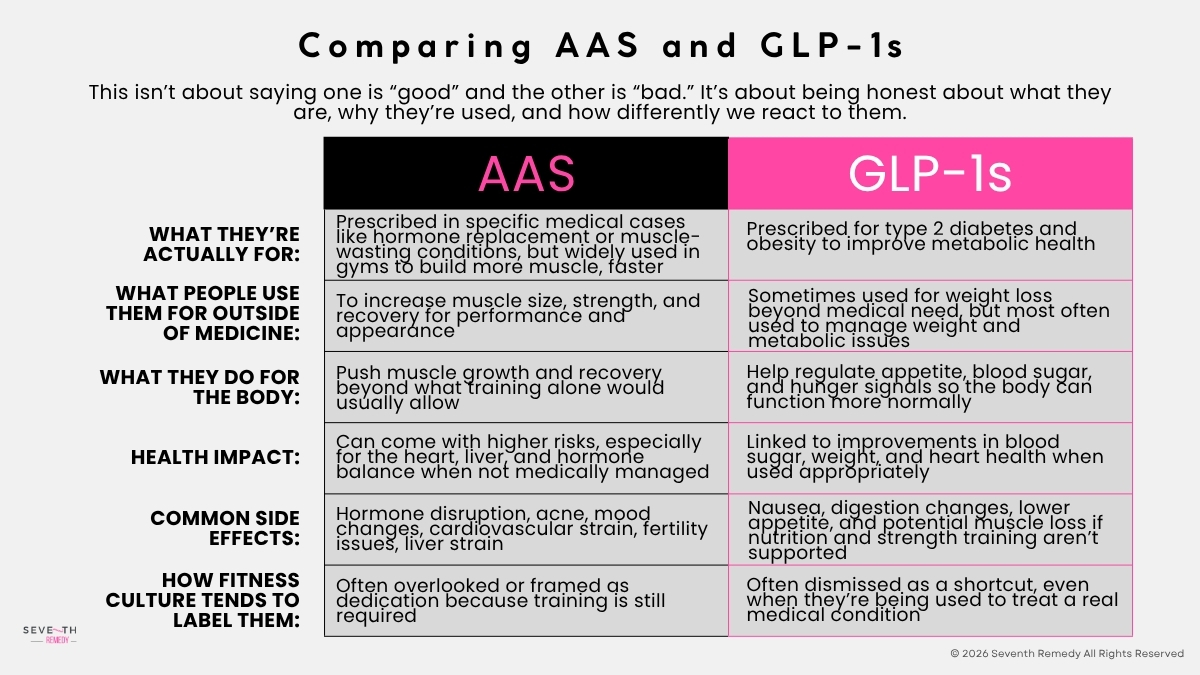
What Are Anabolic-Androgenic Steroids (AAS)?
Anabolic-androgenic steroids, usually called AAS, are synthetic versions of testosterone that are used to increase muscle growth, strength, and recovery.
The word “anabolic” refers to building tissue, especially muscle. “Androgenic” refers to male-related effects connected to testosterone, like facial hair growth, acne, a deeper voice, and changes in hormone balance.
These medications do have legitimate medical uses. Doctors may prescribe them for certain hormone disorders or conditions that cause severe muscle and tissue loss4. But using anabolic steroids for bodybuilding or performance enhancement without a prescription is illegal.
They also come with real risks. Steroid use can affect the liver, heart, blood pressure, hormones, fertility, mood, and mental health. They can also increase injury risk because muscle strength can improve faster than connective tissue like tendons and ligaments are able to adapt5. That mismatch can put a lot of stress on the body.
What GLP-1 Medications Actually Do
GLP-1 medications work by mimicking hormones involved in appetite, blood sugar regulation, digestion, and fullness. For many people, they help them feel full sooner, reduce constant food thoughts, and support more stable appetite regulation and metabolic function.
They are prescribed for obesity and type 2 diabetes, both of which are recognized metabolic diseases. When used appropriately, these medications can help people lose body weight, stabilize blood sugar levels, and improve other health markers.
Like any medication, they can also come with side effects. The most common are nausea, constipation, diarrhea, fatigue, or simply not feeling very hungry. That last one may sound helpful at first, but it can become a problem if someone is not eating enough to support their body, especially if they are trying to exercise, recover properly, or maintain muscle mass during weight loss. There are also less common but more serious risks that should be part of a conversation with a doctor.
One thing I think gets misunderstood often is that GLP-1 medications do not automatically make someone healthy or fit. They do not build muscle, improve cardiovascular fitness, or create healthy habits on their own. People still have to learn how to eat well, strength train, recover, manage stress, and take care of themselves consistently. That still takes effort, discipline, and change.
Who I’m Actually Talking About
I want to be very clear about something before everyone gets defensive. This isn’t about everyone.
Of course, there are people who do not want to change their habits, avoid responsibility, or expect a medication to do everything for them. That exists in every area of health and fitness. It would be naïve to pretend it doesn’t. But those are not the women I work with every day.
The women I meet are showing up after years of avoiding exercise because they were embarrassed, uncomfortable, in pain, overwhelmed, or simply did not know where to start. They are learning how to move in bodies that can feel different from month to month as their weight, balance, strength, and energy levels change.
Many are trying to rebuild their relationship with food after years of constantly feeling hungry, thinking about food all day, or being told to just eat less and use more willpower. Now they are learning how to eat enough protein, support muscle, recover properly, and fuel their body in a healthier way.
They ask questions. They want to understand strength training, recovery, stress, sleep, nutrition, and how to take care of themselves long term. They invest time, energy, money, and effort into trying to do this well.
That is not laziness. If anything, it is often the first time their effort finally has the biological support it needed to actually move them forward. GLP-1 medications do not replace effort. They help create a more stable foundation so that effort has a chance to work.
Obesity Is Not Just A “Try Harder” Problem
We spend a lot of time talking about how someone got here, and of course that’s important. But at some point, the focus has to shift to what actually helps someone move forward without ignoring what led them here in the first place.
One of the biggest problems is that obesity is still often treated like a character flaw instead of a biological condition. People act like body weight is only about discipline and choices, when in reality there are entire systems involved in regulating hunger, fullness, energy use, and body weight.
Things like:
- Hormones such as leptin, ghrelin, GLP-1, and PYY help regulate hunger and fullness
- The brain works to defend a certain body weight, even when someone is actively trying to lose weight
- Energy regulation systems can push back against weight loss, making it harder to sustain
GLP-1 medications work within those systems. So when someone says the meds work because they make people just eat less, they’re ignoring the biology the medication is actually helping regulate.
That does not mean personal responsibility doesn’t matter. Habits, proper nutrition, and movement still very much do. But for some people, the systems involved in appetite and weight regulation are not functioning the way they should, and that changes everything.
So if someone is using medical support to build better habits, get stronger, and take care of themselves, why is that effort so easy to dismiss, especially in a space where other forms of enhancement are already accepted?
Reducing obesity treatment down to cheating oversimplifies a very complex biological reality.
The Real Problem Is How We Define “Earned”
If we say we value discipline, effort, and personal responsibility, then we should recognize it when it shows up, even if it doesn’t look the way we expected.
To me, health was never supposed to be about proving suffering, earning punishment, or making sure someone struggled enough before they deserved support. It should be about helping people take better care of the body they live in.
And honestly, that is what I see many women trying to do when they start this process. They are trying to move more, eat better, get stronger, improve their health, and rebuild trust with themselves after years of frustration, shame, or feeling stuck.
It does not have to look perfect to be real. But when someone is genuinely making changes and trying to move their life in a healthier direction, I think that deserves support instead of automatic criticism.
Part of helping people move forward is also being honest enough to recognize that different people may need different tools to get there.
Resource
- Sagoe D, Molde H, Andreassen CS, Torsheim T, Pallesen S. The global epidemiology of anabolic-androgenic steroid use: a meta-analysis and meta-regression analysis. Ann Epidemiol. 2014 May;24(5):383-98. doi: 10.1016/j.annepidem.2014.01.009. Epub 2014 Jan 30. PMID: 24582699. https://pubmed.ncbi.nlm.nih.gov/24582699/ ↩︎
- Piatkowski T, Whiteside B, Robertson J, Henning A, Lau EHY, Dunn M. What is the prevalence of anabolic-androgenic steroid use among women? A systematic review. Addiction. 2024 Dec;119(12):2088-2100. doi: 10.1111/add.16643. Epub 2024 Aug 12. PMID: 39134450. https://pubmed.ncbi.nlm.nih.gov/39134450/ ↩︎
- https://www.kff.org/public-opinion/poll-1-in-8-adults-say-they-are-currently-taking-a-glp-1-drug-for-weight-loss-diabetes-or-another-condition-even-as-half-say-the-drugs-are-difficult-to-afford/ ↩︎
- https://my.clevelandclinic.org/health/treatments/5521-anabolic-steroids ↩︎
- Kanayama G, DeLuca J, Meehan WP 3rd, Hudson JI, Isaacs S, Baggish A, Weiner R, Micheli L, Pope HG Jr. Ruptured Tendons in Anabolic-Androgenic Steroid Users: A Cross-Sectional Cohort Study. Am J Sports Med. 2015 Nov;43(11):2638-44. doi: 10.1177/0363546515602010. Epub 2015 Sep 11. PMID: 26362436; PMCID: PMC5206906. https://pmc.ncbi.nlm.nih.gov/articles/PMC5206906/ ↩︎
Photo Credits
GLP-1 Vs. Steroid Vials by Seventh Remedy
Comparing AAS to GLP-1 by Seventh Remedy

For many women, GLP-1 medications have made weight...
If you’re living with type 2 diabetes or obesity...



Most women on GLP-1s aren’t avoiding exercise...

When you start taking better care of yourself, the...

Losing weight is not easy, no matter how much...