GLP-1s vs Steroids: The Double Standard That No One Talks About in Fitness

GLP-1s vs. Steroids

The fitness industry can be incredibly motivating, supportive, and life-changing. I’ve built my career in it because I genuinely believe movement, strength, and better health can change people’s lives. But like any space, it also has its flaws, and this is one of the biggest ones I keep noticing.

The moment I mention that I work with women using GLP-1 medications, I can sometimes feel the shift in the conversation. The reactions change, and the assumptions start. What stands out to me is how differently fitness culture responds to certain kinds of help.

A man can use anabolic steroids to build more muscle, recover faster, and push his physique beyond what training alone would normally allow, and many people will still describe him as dedicated, disciplined, or serious about fitness. But when a woman uses a GLP-1 medication to treat obesity, insulin resistance, or type 2 diabetes, the conversation often turns into cheating, shortcuts, laziness, or taking the easy way out.

That disconnect says a lot, and I don’t think it’s only about the medication itself. I think it reveals who fitness culture respects for getting help, who it questions for it, and how differently we view performance enhancement for aesthetics versus medical treatment for obesity and metabolic disease.

Anabolic steroids have existed in gym culture for decades, long before GLP-1 medications became widely used for obesity treatment. Still, GLP-1 use is constantly criticized in a way that feels hard to ignore once you start really noticing it.

Why Muscle Enhancement Gets Treated Differently

When you look at the numbers by gender, there is a pretty obvious pattern. Anabolic steroid use in gym and bodybuilding spaces is much higher in men12, while GLP-1 and similar weight loss medications are used more often by women3.

I think that exposes a bias that has existed in fitness culture for a long time. Muscle is treated as something earned through effort, while body weight is treated as something controlled through willpower.

Bigger, leaner, more muscular bodies (often associated with males) are admired. People look the other way or stay quiet about enhancement. Steroids usually get a pass on the “shortcut” label because everyone knows they don’t work without intense training, and there’s still this belief that the person is putting in the work, even if they’re using something to directly shift the outcome.

Larger bodies or weight struggles (more often associated with females) are judged. People question the method, the effort, and whether it was really earned.

What gets missed is that GLP-1 use still requires major lifestyle changes for many people. I see women learning how to eat differently, strength train consistently, manage protein intake, regulate stress, and navigate a body that can feel unfamiliar from one moment to the next. Sometimes this is all happening while also dealing with the changes that come with peri/menopause. That is physical work, mental work, and emotional work, too.

At the core of it, both situations involve someone using a tool to change an outcome, yet the reaction is often completely different. We are comfortable with people using assistance when it moves them toward a body we admire, but we question it when it challenges what we believe about personal responsibility.
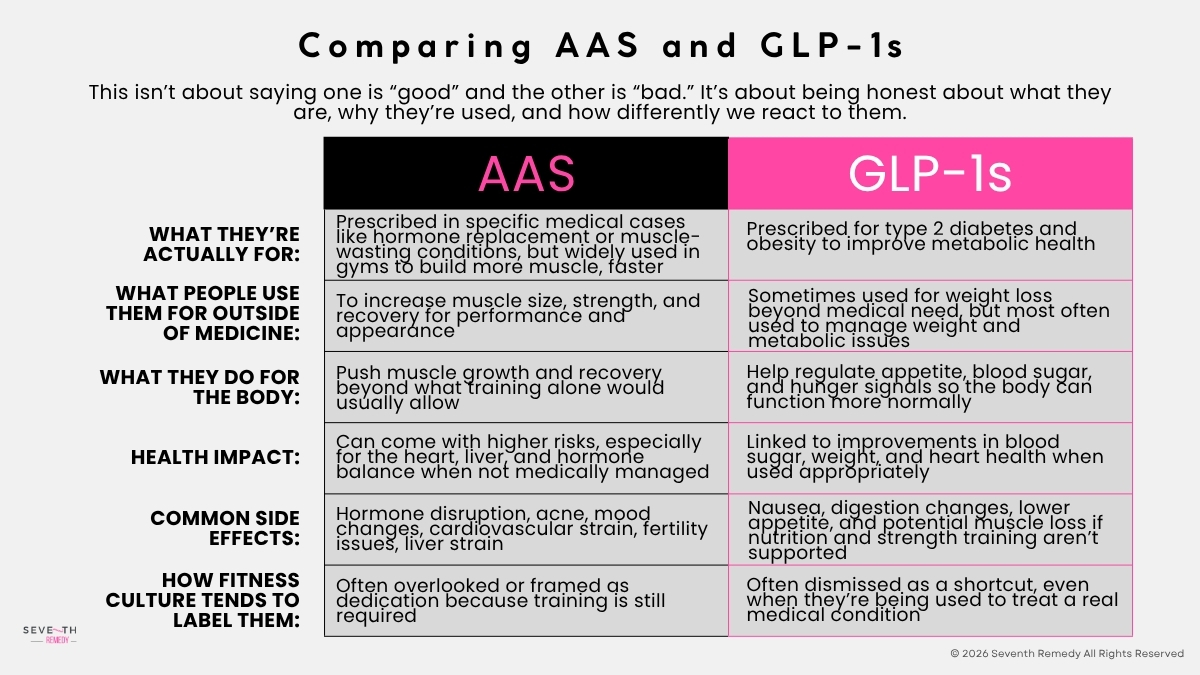
AAS and GLP-1s Comparison

What Are Anabolic-Androgenic Steroids (AAS)?

Anabolic-androgenic steroids, usually called AAS, are synthetic versions of testosterone that are used to increase muscle growth, strength, and recovery.

The word “anabolic” refers to building tissue, especially muscle. “Androgenic” refers to male-related effects connected to testosterone, like facial hair growth, acne, a deeper voice, and changes in hormone balance.

These medications do have legitimate medical uses. Doctors may prescribe them for certain hormone disorders or conditions that cause severe muscle and tissue loss4. But using anabolic steroids for bodybuilding or performance enhancement without a prescription is illegal.

They also come with real risks. Steroid use can affect the liver, heart, blood pressure, hormones, fertility, mood, and mental health. They can also increase injury risk because muscle strength can improve faster than connective tissue like tendons and ligaments are able to adapt5. That mismatch can put a lot of stress on the body.
THE REMEDY METHOD BLOG POSTS

What GLP-1 Medications Actually Do

GLP-1 medications  work by mimicking hormones involved in appetite, blood sugar regulation, digestion, and fullness. For many people, they help them feel full sooner, reduce constant food thoughts, and support more stable appetite regulation and metabolic function.

They are prescribed for obesity and type 2 diabetes, both of which are recognized metabolic diseases. When used appropriately, these medications can help people lose body weight, stabilize blood sugar levels, and improve other health markers.

Like any medication, they can also come with side effects. The most common are nausea, constipation, diarrhea, fatigue, or simply not feeling very hungry. That last one may sound helpful at first, but it can become a problem if someone is not eating enough to support their body, especially if they are trying to exercise, recover properly, or maintain muscle mass during weight loss. There are also less common but more serious risks that should be part of a conversation with a doctor.

One thing I think gets misunderstood often is that GLP-1 medications do not automatically make someone healthy or fit. They do not build muscle, improve cardiovascular fitness, or create healthy habits on their own. People still have to learn how to eat well, strength train, recover, manage stress, and take care of themselves consistently. That still takes effort, discipline, and change.

Who I’m Actually Talking About

I want to be very clear about something before everyone gets defensive. This isn’t about everyone.

Of course, there are people who do not want to change their habits, avoid responsibility, or expect a medication to do everything for them. That exists in every area of health and fitness. It would be naïve to pretend it doesn’t. But those are not the women I work with every day.

The women I meet are showing up after years of avoiding exercise because they were embarrassed, uncomfortable, in pain, overwhelmed, or simply did not know where to start. They are learning how to move in bodies that can feel different from month to month as their weight, balance, strength, and energy levels change.

Many are trying to rebuild their relationship with food after years of constantly feeling hungry, thinking about food all day, or being told to just eat less and use more willpower. Now they are learning how to eat enough protein, support muscle, recover properly, and fuel their body in a healthier way.

They ask questions. They want to understand strength training, recovery, stress, sleep, nutrition, and how to take care of themselves long term. They invest time, energy, money, and effort into trying to do this well.

That is not laziness. If anything, it is often the first time their effort finally has the biological support it needed to actually move them forward. GLP-1 medications do not replace effort. They help create a more stable foundation so that effort has a chance to work.

Obesity Is Not Just A “Try Harder” Problem

We spend a lot of time talking about how someone got here, and of course that’s important. But at some point, the focus has to shift to what actually helps someone move forward without ignoring what led them here in the first place.

One of the biggest problems is that obesity is still often treated like a character flaw instead of a biological condition. People act like body weight is only about discipline and choices, when in reality there are entire systems involved in regulating hunger, fullness, energy use, and body weight.

Things like:

  • Hormones such as leptin, ghrelin, GLP-1, and PYY help regulate hunger and fullness
  • The brain works to defend a certain body weight, even when someone is actively trying to lose weight
  • Energy regulation systems can push back against weight loss, making it harder to sustain

GLP-1 medications work within those systems. So when someone says the meds work because they make people just eat less, they’re ignoring the biology the medication is actually helping regulate.

That does not mean personal responsibility doesn’t matter. Habits, proper nutrition, and movement still very much do. But for some people, the systems involved in appetite and weight regulation are not functioning the way they should, and that changes everything.

So if someone is using medical support to build better habits, get stronger, and take care of themselves, why is that effort so easy to dismiss, especially in a space where other forms of enhancement are already accepted?

Reducing obesity treatment down to cheating oversimplifies a very complex biological reality.

The Real Problem Is How We Define “Earned”

If we say we value discipline, effort, and personal responsibility, then we should recognize it when it shows up, even if it doesn’t look the way we expected.  

To me, health was never supposed to be about proving suffering, earning punishment, or making sure someone struggled enough before they deserved support. It should be about helping people take better care of the body they live in.

And honestly, that is what I see many women trying to do when they start this process. They are trying to move more, eat better, get stronger, improve their health, and rebuild trust with themselves after years of frustration, shame, or feeling stuck.

It does not have to look perfect to be real. But when someone is genuinely making changes and trying to move their life in a healthier direction, I think that deserves support instead of automatic criticism.

Part of helping people move forward is also being honest enough to recognize that different people may need different tools to get there.


  1. Sagoe D, Molde H, Andreassen CS, Torsheim T, Pallesen S. The global epidemiology of anabolic-androgenic steroid use: a meta-analysis and meta-regression analysis. Ann Epidemiol. 2014 May;24(5):383-98. doi: 10.1016/j.annepidem.2014.01.009. Epub 2014 Jan 30. PMID: 24582699. https://pubmed.ncbi.nlm.nih.gov/24582699/ ↩︎
  2. Piatkowski T, Whiteside B, Robertson J, Henning A, Lau EHY, Dunn M. What is the prevalence of anabolic-androgenic steroid use among women? A systematic review. Addiction. 2024 Dec;119(12):2088-2100. doi: 10.1111/add.16643. Epub 2024 Aug 12. PMID: 39134450. https://pubmed.ncbi.nlm.nih.gov/39134450/ ↩︎
  3. https://www.kff.org/public-opinion/poll-1-in-8-adults-say-they-are-currently-taking-a-glp-1-drug-for-weight-loss-diabetes-or-another-condition-even-as-half-say-the-drugs-are-difficult-to-afford/ ↩︎
  4. https://my.clevelandclinic.org/health/treatments/5521-anabolic-steroids ↩︎
  5. Kanayama G, DeLuca J, Meehan WP 3rd, Hudson JI, Isaacs S, Baggish A, Weiner R, Micheli L, Pope HG Jr. Ruptured Tendons in Anabolic-Androgenic Steroid Users: A Cross-Sectional Cohort Study. Am J Sports Med. 2015 Nov;43(11):2638-44. doi: 10.1177/0363546515602010. Epub 2015 Sep 11. PMID: 26362436; PMCID: PMC5206906. https://pmc.ncbi.nlm.nih.gov/articles/PMC5206906/ ↩︎

Photo Credits

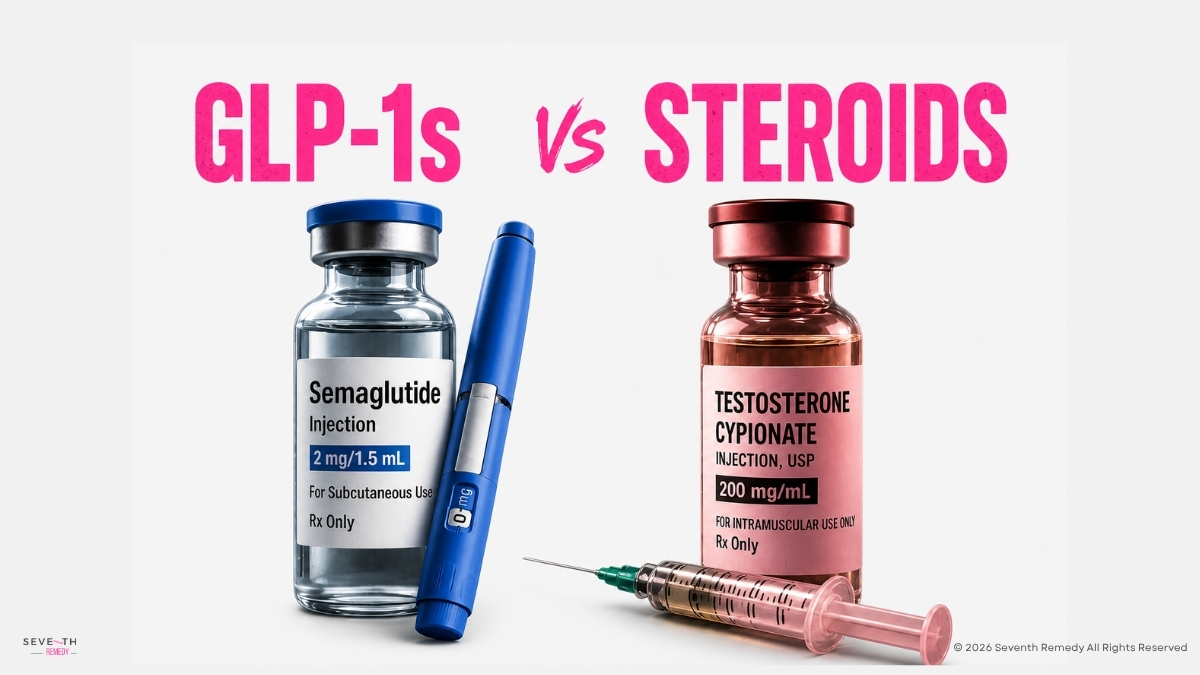
GLP-1 Vs. Steroid Vials by Seventh Remedy

Comparing AAS to GLP-1 by Seventh Remedy

This article is for educational purposes and is not intended to replace medical consultation. Always consult a healthcare professional before making health-related decisions. If something here doesn’t sit right with you, take a closer look. Ask questions, look into it further, and make sure it makes sense for your body and your situation. When relevant, I include references to support key points so you can explore things more on your own.

Read the full disclaimer here. 

Editorial Note: Portions of this article may be supported by editorial tools, including AI. All content is researched, written, reviewed, and approved by Claudia Dzina, CPT, before publication

The Remedy Method

Most exercise programs focus on what to do.
This work focuses on helping your body feel steady and capable again as it changes.

Training is guided, intentional, and paced to support strength, balance, and confidence in real life, not just workouts.

If your body feels different and you’re not sure where to start, this is a supportive place to begin.

This is where it begins.

Share a bit about where you are so I can meet you there with the right kind of training support.

Heart Rate & Effort Calculator

Understand Your Heart Rate Zones 

Estimate your heart rate zones and learn what each effort level should actually feel like.

Heart rate zones can help you understand how hard your body is working during cardio, walking, strength circuits, or conditioning. But heart rate is only one way to measure intensity. Your heart rate can be affected by sleep, stress, hydration, medication, caffeine, fitness level, and even the temperature in the room.

This calculator gives you an estimate that you can compare with your breathing, talk test, and rate of perceived exertion (RPE) so you can understand effort in a more practical way.

Use heart rate as a guide. If your smartwatch or fitness device says one thing but your body says something else, pay attention.

Check in with yourself and ask:

  • Can I talk?
  • Can I control my breathing?
  • Could I sustain this pace?
  • Do I feel steady or overwhelmed?
  • Does this match the goal of today’s workout?

Age (years)

This tool is for education only. It does not diagnose, prescribe exercise intensity, or replace guidance from your medical team. If you take medication that affects heart rate or have cardiovascular concerns, ask your medical provider what intensity range is appropriate for you.

Is The Remedy Method
Right For Me?

(Find out in less than 1 minute!)

Answer a few quick questions about how your body feels and how you like to exercise. This will help you see if The Remedy Method, which blends corrective exercise, Pilates-style control, and strength training for women on GLP-1 medications, is a good fit for you.

1. Are you currently using a GLP-1 medication?

2. How often do you notice nausea, dizziness, low energy, or fast fatigue during movement?

3. Have you noticed changes in your balance, coordination, or stability since your body started changing?

4. Do certain movements feel awkward or disconnected now, like squats, lunges, bending, stepping, or getting off the floor?

5. Do you notice any of these when you move or exercise? (Select all that apply.)

6. Do you feel comfortable exercising in a public gym or group class?

7. Does the idea of guided instruction sound helpful right now?

8. Have you ever felt rushed, judged, or misunderstood by past trainers or programs?

9. What matters most to you right now? (Select all that apply.)

10. Do you want a structured plan with phases that build on each other?

11. Can you commit to training at home with simple equipment or none at all?

12. Would you benefit from having a trainer watch your form and guide your pacing in real time over Zoom?

This quiz is for education and reflection. It is not a medical screen or diagnosis. Always follow the guidance of your medical team for movement and exercise.

GLP-1 Nutrition
Reflection Tool

A quick check-in on your last meal and today’s patterns so you can see what your body might be asking for next.

Step 1 of 4
Think of your last meal. How many different colors were on your plate?
Where did most of the color come from?
What was the main protein in your last meal?
How was that protein prepared?
How many sides did you have with that meal?
What best describes your sides? (Choose all that apply.)
How were your sides prepared?
What was the main starch or grain at your last meal?
How much of your plate did that starch or grain take up?
Which of these were part of your last meal? (Choose all that apply.)
About how long did it take you to eat your last meal?
What were you doing while you ate?
Where did your last meal come from?
How long did it take to get that meal from “I’m hungry” to “let’s eat”?
How easy was this meal to put together?
Were you able to finish everything on your plate?
How did you feel 30–60 minutes after that meal?
So far today, how many different fruits have you eaten?
So far today, how many different vegetables have you eaten?
How many times have you reached for a snack today?
Which of these sounds most like your typical snack today?
What color were most of your drinks today?
Did you add anything to your drinks to make them taste better?
In the past week, how often have you felt too full to finish a small or normal-sized meal?
In the past week, how often have you felt nausea or strong discomfort after eating?
In the past week, how often have you gone more than 5 waking hours without eating anything?
Thinking about a typical day, how do your meals usually look?
Over the past week, how has your sleep been?
Do you have any kind of evening wind-down routine?
Your GLP-1 Meal Reflection
What this might be telling you
Optional: next-step ideas

    BMI & Waist Check

    Use this tool to look at your Body Mass Index (BMI) and waist size.

    BMI compares your height and weight to estimate general body size. It does not measure fat or muscle and cannot show how your body is changing with strength training or GLP-1 use. It is simply a numerical estimate.

    Waist size provides additional information because abdominal fat is more closely linked to metabolic risk than fat stored in other areas. Measuring the waist gives a better idea of where the body is holding weight.

    Both BMI and waist size can change quickly when someone starts a GLP-1. Muscle, water, and fat often shift at different rates, so these numbers work best as general reference points rather than something to obsess over.

    This tool gives you a simple snapshot you can use for your own self-awareness or just to know before doctor’s appointments. It’s one of several things to pay attention to, along with movement quality, strength levels, recovery, and daily well-being.

    Waist size is optional. The tool will still calculate your BMI if you skip that section.

    BMI Categories:


    • Underweight: Below 18.5
    • Healthy weight: 18.5 – 24.9
    • Overweight: 25 – 29.9
    • Obese: 30 or greater
      • Class I (Mild): 30–34.9
      • Class II (Moderate): 35–39.9
      • Class III (Severe): 40 or greater

    Unit of measure

    Sex

    Age (years)

    Height (feet)

    Height (inches)

    Weight (pounds)

    Waist circumference (inches, optional)

    This tool is for education only. It cannot diagnose medical conditions. If you have new symptoms or health concerns, talk with your medical team for guidance. For adults only. BMI is one data point and does not reflect muscle, body composition changes on GLP-1s, or overall health.

    Is The Remedy Method
    Right For Me?

    1. Are you currently using a GLP-1 medication?

    2. How often do you notice nausea, dizziness, low energy, or fast fatigue during movement?

    3. Have you noticed changes in your balance, coordination, or stability since your body started changing?

    4. Do certain movements feel awkward or disconnected now, like squats, lunges, bending, stepping, or getting off the floor?

    5. Do you notice any of these when you move or exercise? (Select all that apply.)

    6. Do you feel comfortable exercising in a public gym or group class?

    7. Does the idea of guided instruction sound helpful right now?

    8. Have you ever felt rushed, judged, or misunderstood by past trainers or programs?

    9. What matters most to you right now? (Select all that apply.)

    10. Do you want a structured plan with phases that build on each other?

    11. Can you commit to training at home with simple equipment or none at all?

    12. Would you benefit from having a trainer watch your form and guide your pacing in real time over Zoom?

    This quiz is for education and reflection. It is not a medical screen or diagnosis. Always follow the guidance of your medical team for movement and exercise.

    Movement Pattern Starting Point

    Answer these questions about how your body feels today. This tool helps you find a safe starting point for key movement patterns if you are using GLP-1 medications or coming back to exercise after weight loss. The goal is to match your body to the right level of support, not to push through pain or fear.

    1. How do your knees feel when you walk, use stairs, or stand up from a chair?

    2. How does your low back feel today?

    3. How steady do you feel on your feet?

    4. Can you safely get down to the floor and back up on your own?

    5. Any foot or ankle pain when you walk or stand?

    6. Right now, how confident do you feel about moving your body?

    This tool is for education only. It cannot diagnose injuries. If you have strong pain, falls, or new symptoms, talk with your health care team before starting or changing your exercise plan.

    GLP-1 Training
    Readiness Check

    Many women notice changes in balance, coordination, and strength as they lose weight. This tool helps you choose movements that feel supportive instead of stressful, so you can build confidence and avoid overloading joints or overworking muscles that are still adjusting.

    1. Have you eaten a small meal or snack in the last 2 to 3 hours?

    2. How is your stomach right now?

    3. How is your energy right now on a scale from 1 to 10?

    4. Have you felt dizzy, faint, or lightheaded when you stand up today?

    5. Any new sharp pain, chest tightness, or trouble breathing since your last workout?

    This tool is for education only and does not replace medical advice. If you ever feel unsure, choose rest and contact your health care team.

    Macro Split Calculator

    First, calculate your daily protein target using the protein calculator.

    Then enter your maintenance calories from the TDEE calculator, or type in a starting estimate, and choose your goal. This calculator adjusts your calories based on that goal and shows you how those calories break down into protein, fats, and carbohydrates. This is called a macro split.

    For women using GLP-1 medications or going through weight loss, this structure is designed to make eating feel more manageable. Protein supports muscle. Fats support hormones and nutrient absorption. Carbohydrates support energy, movement, and recovery.

    Protein recommendations online can be confusing because the official Recommended Dietary Allowance (RDA) is designed to prevent deficiency, not necessarily support muscle retention during weight loss. The RDA for protein is 0.8 grams per kilogram of body weight, but many experts recommend closer to 1.2–1.6 g/kg during weight loss or resistance training. That is why our Daily Protein Target Calculator starts at 1.2 g/kg.

    Fat intake is usually recommended as a percentage of total calories rather than a fixed number. For most adults, about 20% to 35% of daily calories coming from fat is considered a balanced range. This calculator keeps fats within a moderate range while balancing protein and carbohydrates based on your calorie needs and goal.

    Carbohydrates help support energy, movement, recovery, and brain function. General nutrition guidelines often place carbohydrate intake within a broad range depending on activity level and calorie needs. Instead of using a rigid percentage, this calculator adjusts carbohydrates based on your calorie intake, protein target, and fat needs while maintaining a minimum intake for daily function and energy levels. However, carbohydrate needs can still vary widely depending on activity level, appetite, medications, and overall calorie intake.

    Your protein target comes directly from the protein calculator. This tool builds the rest of your intake around that number.

    This is a starting point, not a prescription. Your medical team may adjust your needs based on your health, labs, medication plan, and appetite.

    kcal

    Use your TDEE number from the TDEE calculator or enter a starting maintenance estimate. This calculator will adjust that number based on your goal before splitting your macros.
    Use my TDEE Calculation

    Adjusted calories: 0 kcal per day

    Protein: 0 g per day

    Fat: 0 g per day

    Carbs: 0 g per day

    This is a starting point, not a prescription. Your medical team may adjust your needs based on your health, labs, and medication plan.

    Daily Protein Target

    Enter your weight and choose how often you strength train. This calculator gives you a daily protein range in grams to help support muscle, recovery, and overall health.

    The Recommended Dietary Allowance (RDA) for protein is 0.8 grams per kilogram of body weight. That amount is the minimum needed for basic health, not for maintaining muscle during weight loss or training.

    People may need more than the RDA when they are:

    • losing weight
    • using GLP-1 medications
    • strength training
    • trying to keep or build muscle
    • over age 35

    This calculator starts at 1.2 grams per kilogram. Think of this as your baseline for muscle protection, not a goal you have to exceed. The range increases slightly based on how often you train. This reflects what your body could use if it is supported with enough food and recovery.

    Because appetite can be lower on GLP-1 medications, you do not need to chase the highest number in the range. Start with the lower end of your range and focus on consistency first. If your appetite allows and your body is responding well, you can gradually work toward the higher end. If not, staying at the lower end is still effective for protecting muscle.

    lb

    Recommended range:

    0 to 0 grams per day

    This range is an estimate based on body weight and strength training level. It is a guide, not a strict rule. Your medical team may adjust your protein needs, especially while you are on GLP-1 medication.

    TDEE & BMR Calculator

    Fill in your details to find your Total Daily Energy Expenditure (TDEE) and Basal Metabolic Rate (BMR).

    Your TDEE is the total amount of energy your body uses in a full day. This includes everything. Your workouts, walking, cleaning, daily movement, shifting posture, fidgeting, and even the energy it takes to digest your food.

    Part of your TDEE is your BMR. Your BMR is the energy your body needs for basic life functions like breathing, circulating blood, maintaining organs, and keeping your body temperature stable. This is what your body would use even if you stayed in bed all day.

    Understanding both numbers is helpful if you are on a GLP-1 or working on your health. Appetite can drop quickly, which makes it easy to undereat without noticing. Knowing your TDEE and BMR shows you how much fuel your body actually needs so you can keep your energy up, protect muscle, and support safe and steady fat loss.

    You can choose from three formulas to calculate these numbers. Mifflin-St. Jeor and Harris-Benedict use height, weight, age, and sex. Katch-McArdle uses body fat percentage if you know it. They use slightly different math equations, but they all estimate the same thing. Mifflin-St. Jeor is generally the most accurate for most people.

    lb
    in

    BMR: 0 kcal per day

    TDEE: 0 kcal per day

    These are estimates. Calculators may read low for people with more muscle and may not work well for people living with obesity. Use as a guide, not an exact number.

    Form-focused. Emotionally aware. Personalized support from the comfort of your home.

    Live Virtual Training Options

    Private, 1:1 via Zoom

    2 Sessions Per Week

    $35–$40 per session

    24 total sessions (12 weeks)

    Pay in Full:

    $840 ($35/Session)

    Best value. One-time payment. | 30-Day Money-Back Guarantee

    Pay Monthly:

    $320/month for 3 months ($40/session)

    Flexible plan.

    3 Sessions Per Week

    $35–$40 per session

    36 total sessions (12 weeks)

    Pay in Full:

    $1,260 ($35/session)

    Best value. One-time payment. | 30-Day Money-Back Guarantee

    Pay Monthly:

    $480/month for 3 months ($40/session)

    Flexible plan.

    Simple. Transparent. No surprises.

    Live, personalized training. No app. No gym. Support that adapts to your body and your life.