What’s The Difference Between a Genetic Mutation and a Predisposition?

An image of a woman with stunning green eyes to depict genetics

Your height, eye color, skin tone, and bone structure are fixed traits. They’re written into your DNA as part of your genetic blueprint and can’t be changed.

But not everything about your body works that way. Plenty of traits are considered dynamic, meaning they’re influenced by how you live, eat, move, manage stress, and so on. These things aren’t permanent or hardwired.

In this post, we’ll break these two down because understanding the difference will allow you to see where you still have influence and where it’s worth putting your energy.


“I can’t help it, it’s genetic.”

We hear things like that a lot in the fitness and wellness world. It’s usually when someone’s dealing with things like chronic fatigue, insulin resistance, high blood pressure, or weight gain.

And to be fair, sometimes genetics really do play a role. But not always in the way people think.

I personally don’t believe people are making excuses when they say this. I think many of them simply don’t know the difference between a genetic mutation (rare, fixed, and very specific) and a genetic predisposition (common and influenced heavily by environment and behavior).

But when we treat both the same, a few problems come up:

  • It gives the impression that everything is out of your hands when it’s not.
  • It can feel discouraging instead of empowering.
  • It can be unfair as it overlooks the real, rare cases where people truly don’t have a choice because their genetics are driving things in a way that lifestyle alone can’t fix.

What Is a Genetic Mutation?

A genetic mutation is a measurable change in your DNA. It’s not something you’re prone to; it’s something you actually have.

You can be born with a mutation (inherited from your parents), or it can happen later in life (developed). Either way, it changes how your body functions at the cellular level.

These mutations are diagnosable medical conditions; they’re not caused by lifestyle. You don’t develop them because you ate a few unbalanced meals, were stressed, or skipped a workout or two. They happen because of an actual alteration in the gene.

There are over 6,000 known genetic disorders1, and they all come down to how specific genes are affected. Some mutations are harmless, while others can lead to serious health conditions. These types of disorders are rare, but when they do show up, they’re usually very noticeable and often diagnosed early because of how strongly they impact the body.

Examples of Diagnosed Genetic Mutations2:

  • Down syndrome – caused by an extra chromosome 21
  • Sickle cell disease – from a specific change in the hemoglobin gene
  • BRCA1/BRCA23 – inherited mutations that raise breast/ovarian cancer risk
  • Cystic fibrosis – due to a faulty CFTR gene
  • Muscular dystrophy – linked to mutations in the DMD gene

What Is a Genetic Predisposition?

This is actually what people mean when they say, “It’s genetic.” And it’s also the one that’s most often misunderstood.

A genetic predisposition means you’re more likely to develop a condition because of your genes, so it’s a risk for sure, but it’s not definite. This means that your genes might make it easier for something like weight gain, diabetes, or depression to develop, but the outcome still depends on what you do.

In other words, epigenetic4 factors, like your behaviors and daily habits, environment, stress, sleep, movement, and food quality, all influence whether those genes get triggered or not. So, your choices can make a real difference, even if something runs in your family.

There are millions of genetic predispositions5. Here are a few of the conditions commonly tied to them:

  • Type 2 diabetes
  • High blood pressure
  • Obesity
  • Kidney stones
  • PCOS
  • Heart disease
  • Depression
  • Some autoimmune conditions

Remember that your genes aren’t punishing you, they’re just challenging you to pay more attention.
An Image of Genetics and DNA

Why This Distinction Matters

If your issue is influenced by lifestyle, that’s not something to feel ashamed of, it’s something to get curious about. Because predisposed doesn’t mean powerless, it means we can use this knowledge to get healthier and feel better.

Here’s how you start:

  • Train in a way that builds strength, stability, and joint protection, especially as you age. Movement is so much more than just how many reps you can do or the number on a scale.

  • Enjoy nutritious foods that balance blood sugar and support your metabolism; food isn’t just about satisfying cravings; it’s about giving your body what it needs to function well.

  • Build sustainable habits. Create routines you truly enjoy and can stick with. You can always adjust over time while learning to meet your body’s real needs.

Even with some high-risk mutations (like BRCA), healthy lifestyle choices can improve outcomes. But with a predisposition, you usually have even more influence than you think.

Which Are You Dealing With?

If you’re unsure whether you’re working with a mutation or a predisposition, here’s a quick gut check.
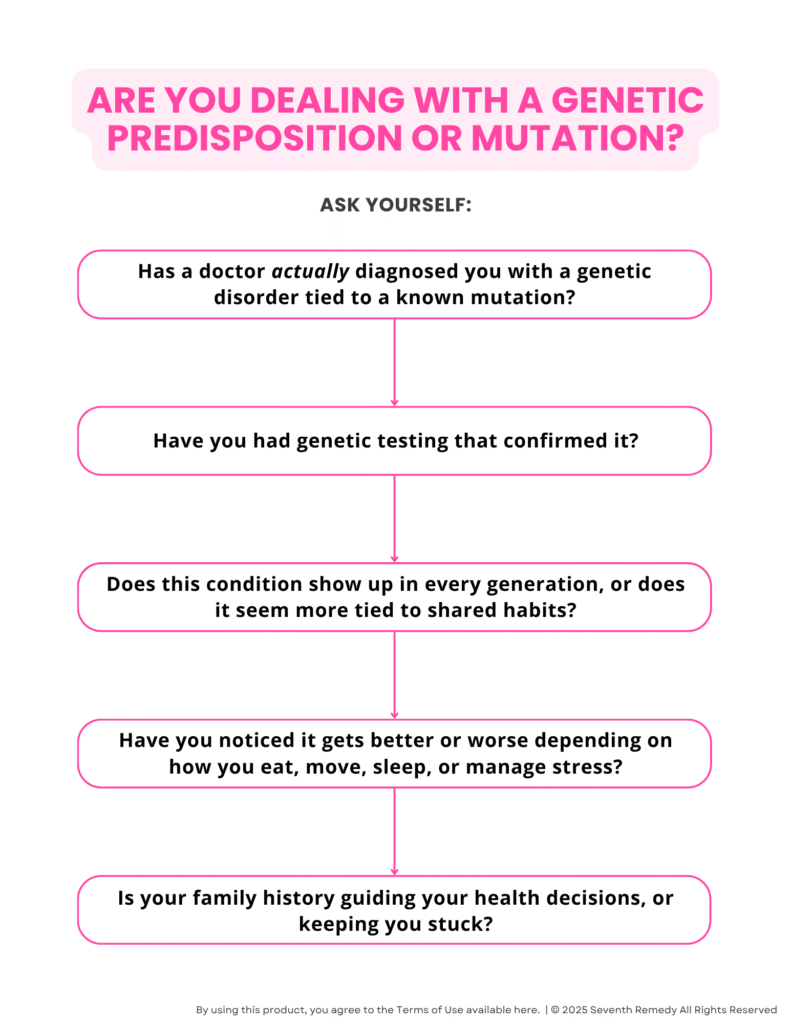
Determining the difference between a genetic mutation and a disposition.

If your symptoms change based on your lifestyle, you’re probably dealing with a predisposition, not a mutation, which is excellent news. It means you have options, and your choices matter, even if they’re harder for you than for someone else.

5 Things You Can Do to Start Taking Control

You don’t need to ignore your family history, but you don’t need to surrender to it either.

1. Stop treating family history like a life sentence

Genetics equals risk, not certainty. If your parents had heart disease or diabetes, take that as motivation, not a reason to give up. You’re not doomed. But you are responsible for what you do next.

2. Audit your habits, not your bloodline (ask yourself)

  • Am I moving my body regularly?
  • Are most of my meals made from real, whole foods?
  • Am I getting enough sleep to function and recover?
  • Do I handle stress or just pretend I’m fine?

If the answer to most of these is “not really,” then no, it’s probably not just genetic. It’s behavioral, too. And behavioral patterns can be changed.

3. Know what’s actually in your control

You can’t rewrite your DNA. But you can control:

  • What you eat
  • How often you move
  • Whether you ignore your body’s signals or learn how it works
  • How you respond when things get hard

This is where change happens, not in your chromosomes, but in your daily choices.

4. Don’t compare your struggle to someone else’s diagnosis

If someone has a confirmed genetic mutation, their path is totally different. Don’t lump your predisposition into the same category; it minimizes what they’re going through, it’s hurtful, and makes it harder to see what you can actually change.

5. Remind yourself: excuses don’t solve anything

You can be honest about your challenges without making them your identity. Yes, it might be harder for you, but that’s even more reason to stay consistent and build habits that work with your body.

Smart Questions to Ask Your Doctor About Real Genetic Risk

If you want real answers, not vague guesses or family assumptions, these questions can help you have a clearer, more productive conversation with your doctor.
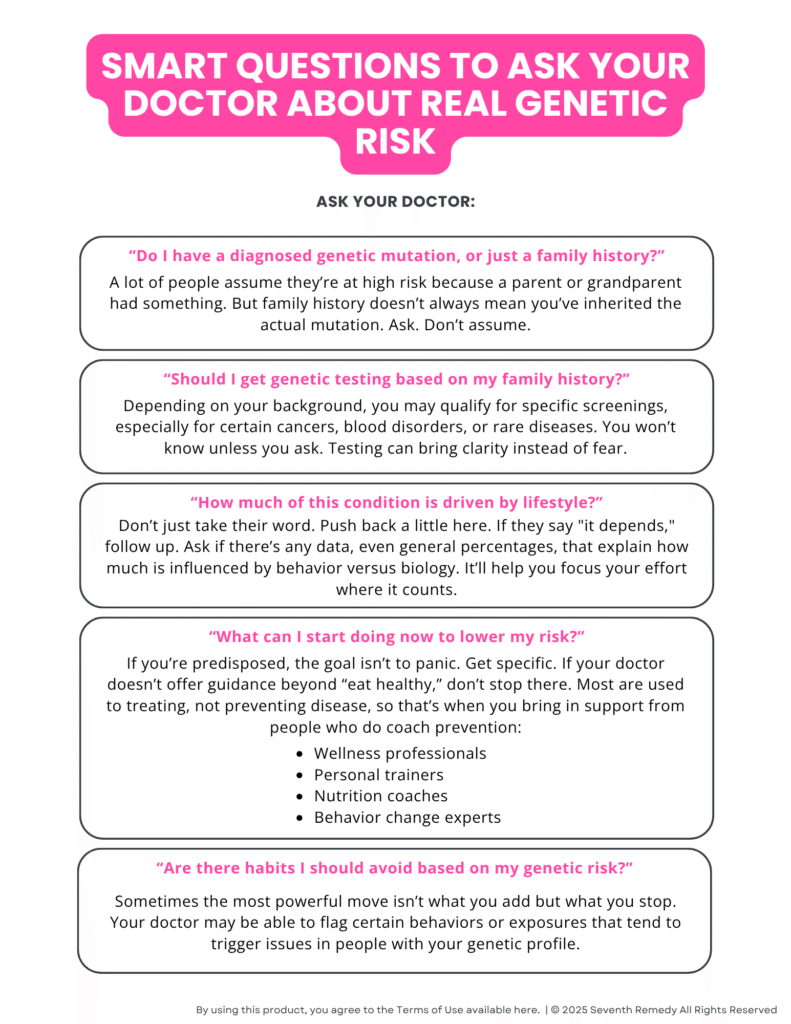
Questions to ask your doctor about the difference between a genetic mutation and a disposition.

A Quick Personal Note: This Isn’t Just Theory

This whole conversation isn’t just something I teach; it’s something I’ve lived.

I have a real genetic predisposition to dental issues: weak enamel, a higher risk for cavities and gum disease, and bone loss in my jaw. These aren’t made-up concerns; they’re written into my DNA and have been confirmed by multiple dentists. I had the kind of genetic setup where losing my teeth was a real possibility.

But I must admit that my lifestyle made it way worse.

In my 20s (I’m in my 40s now), I smoked, drank a ton of soda, and ate lots of sweets. And I should have visited my dentist every three months instead of six, knowing my genetic risks.

So, when things finally got bad enough to deal with, it took multiple surgeries, bone grafts, cosmetic repairs, and a painful reminder of what happens when we ignore the part we can control.

Could I have avoided it completely? Maybe not. But I 100% could have made it less severe, less expensive, and less painful.

This is why I push so hard for understanding the difference between a genetic predisposition and a genetic mutation, and not using either as an excuse to avoid taking action. 

The Bottom Line

Living with a genetic mutation is not the same as having a genetic predisposition.

When someone is born with a condition like Down syndrome or cystic fibrosis, no amount of sleep, stress management, or strength training will undo that. That’s their reality, and they carry it every day, often with a kind of resilience most of us can’t imagine.

That’s why it matters how we use the word “genetic.” When we apply it too casually, especially to patterns that can be influenced, we risk minimizing the serious challenges faced by people with true genetic mutations.

And if you’ve been leaning on “genetics” as your explanation, I get it. I honestly do. That’s a real and human response to feeling stuck or overwhelmed.

But at the same time, we do ourselves a disservice by overlooking what’s still in our control. Because even if you’re predisposed to something, your daily choices and behaviors still matter.


Resources

  1. OMIM Gene Map Statistics https://www.omim.org/statistics/geneMap ↩︎
  2. Wikipedia List of genetic disorders https://en.wikipedia.org/wiki/List_of_genetic_disorders ↩︎
  3. NIH BRCA1- and BRCA2-Associated Hereditary Breast and Ovarian Cancer Petrucelli N, Daly MB, Pal T. BRCA1- and BRCA2-Associated Hereditary Breast and Ovarian Cancer. 1998 Sep 4 [Updated 2025 Mar 20]. In: Adam MP, Feldman J, Mirzaa GM, et al., editors. GeneReviews® [Internet]. Seattle (WA): University of Washington, Seattle; 1993-2025. Available from: https://www.ncbi.nlm.nih.gov/books/NBK1247/ ↩︎
  4. Cleveland Clinic https://my.clevelandclinic.org/health/articles/epigenetics ↩︎
  5. NIH 275 Million New Genetic Variants Identified in NIH Precision Medicine Data https://allofus.nih.gov/article/announcement-275-million-new-genetic-variants-identified-nih-precision-medicine-data ↩︎

Photo Credits

Green Eyes of a Woman by AdinaVoicu – Pixabay

Science Original Biotechnology DNA Illustration by Billion Images
Editorial Note: Portions of this article were supported by editorial tools, including AI. All content is researched, written, and reviewed by me before publication.

This article is for educational purposes and is not intended to replace medical consultation. Always consult a healthcare professional before making health-related decisions.

Read the full disclaimer here. 

The Remedy Method

Most programs teach exercise.

The Remedy Method retrains how your body communicates: how your brain, muscles, and movement work together again after change.

It blends corrective exercise, Pilates control, and progressive strength in a way that helps your body relearn balance, rebuild strength, and move with confidence again.

If your body feels different and you’re not sure where to start, this is the method designed for exactly that.

Join the Waitlist for
The Remedy Personal Training Program

This waitlist doesn’t go into a black hole. I personally review every name on this list and reach out when new spaces open up.

    This is where it begins.

    Before we book anything, I’d love to hear your story. Every woman’s GLP-1 path is unique, and this form gives me a sense of what matters most to you right now. From there, I’ll follow up personally so we can decide together what feels best next.

    Is The Remedy Method
    Right For Me?

    1. Are you currently using a GLP-1 medication?

    2. How often do you notice nausea, dizziness, low energy, or fast fatigue during movement?

    3. Have you noticed changes in your balance, coordination, or stability since your body started changing?

    4. Do certain movements feel awkward or disconnected now, like squats, lunges, bending, stepping, or getting off the floor?

    5. Do you notice any of these when you move or exercise? (Select all that apply.)

    6. Do you feel comfortable exercising in a public gym or group class?

    7. Does the idea of guided instruction sound helpful right now?

    8. Have you ever felt rushed, judged, or misunderstood by past trainers or programs?

    9. What matters most to you right now? (Select all that apply.)

    10. Do you want a structured plan with phases that build on each other?

    11. Can you commit to training at home with simple equipment or none at all?

    12. Would you benefit from having a trainer watch your form and guide your pacing in real time over Zoom?

    This quiz is for education and reflection. It is not a medical screen or diagnosis. Always follow the guidance of your medical team for movement and exercise.

    GLP-1 Nutrition
    Reflection Tool

    A quick check-in on your last meal and today’s patterns so you can see what your body might be asking for next.

    Step 1 of 4
    Think of your last meal. How many different colors were on your plate?
    Where did most of the color come from?
    What was the main protein in your last meal?
    How was that protein prepared?
    How many sides did you have with that meal?
    What best describes your sides? (Choose all that apply.)
    How were your sides prepared?
    What was the main starch or grain at your last meal?
    How much of your plate did that starch or grain take up?
    Which of these were part of your last meal? (Choose all that apply.)
    About how long did it take you to eat your last meal?
    What were you doing while you ate?
    Where did your last meal come from?
    How long did it take to get that meal from “I’m hungry” to “let’s eat”?
    How easy was this meal to put together?
    Were you able to finish everything on your plate?
    How did you feel 30–60 minutes after that meal?
    So far today, how many different fruits have you eaten?
    So far today, how many different vegetables have you eaten?
    How many times have you reached for a snack today?
    Which of these sounds most like your typical snack today?
    What color were most of your drinks today?
    Did you add anything to your drinks to make them taste better?
    In the past week, how often have you felt too full to finish a small or normal-sized meal?
    In the past week, how often have you felt nausea or strong discomfort after eating?
    In the past week, how often have you gone more than 5 waking hours without eating anything?
    Thinking about a typical day, how do your meals usually look?
    Over the past week, how has your sleep been?
    Do you have any kind of evening wind-down routine?
    Your GLP-1 Meal Reflection
    What this might be telling you
    Optional: next-step ideas

      BMI & Waist Check

      Unit of measure

      Sex

      Age (years)

      Height (feet)

      Height (inches)

      Weight (pounds)

      Waist circumference (inches, optional)

      This tool is for education only. It cannot diagnose medical conditions. If you have new symptoms or health concerns, talk with your medical team for guidance. For adults only. BMI is one data point and does not reflect muscle, body composition changes on GLP-1s, or overall health.

      Is The Remedy Method
      Right For Me?

      1. Are you currently using a GLP-1 medication?

      2. How often do you notice nausea, dizziness, low energy, or fast fatigue during movement?

      3. Have you noticed changes in your balance, coordination, or stability since your body started changing?

      4. Do certain movements feel awkward or disconnected now, like squats, lunges, bending, stepping, or getting off the floor?

      5. Do you notice any of these when you move or exercise? (Select all that apply.)

      6. Do you feel comfortable exercising in a public gym or group class?

      7. Does the idea of guided instruction sound helpful right now?

      8. Have you ever felt rushed, judged, or misunderstood by past trainers or programs?

      9. What matters most to you right now? (Select all that apply.)

      10. Do you want a structured plan with phases that build on each other?

      11. Can you commit to training at home with simple equipment or none at all?

      12. Would you benefit from having a trainer watch your form and guide your pacing in real time over Zoom?

      This quiz is for education and reflection. It is not a medical screen or diagnosis. Always follow the guidance of your medical team for movement and exercise.

      Movement Pattern Starting Point

      1. How do your knees feel when you walk, use stairs, or stand up from a chair?

      2. How does your low back feel today?

      3. How steady do you feel on your feet?

      4. Can you safely get down to the floor and back up on your own?

      5. Any foot or ankle pain when you walk or stand?

      6. Right now, how confident do you feel about moving your body?

      This tool is for education only. It cannot diagnose injuries. If you have strong pain, falls, or new symptoms, talk with your health care team before starting or changing your exercise plan.

      GLP-1 Training
      Readiness Check

      1. Have you eaten a small meal or snack in the last 2 to 3 hours?

      2. How is your stomach right now?

      3. How is your energy right now on a scale from 1 to 10?

      4. Have you felt dizzy, faint, or lightheaded when you stand up today?

      5. Any new sharp pain, chest tightness, or trouble breathing since your last workout?

      This tool is for education only and does not replace medical advice. If you ever feel unsure, choose rest and contact your health care team.

      Macro Split Calculator

      kcal

      You can use your TDEE number from the TDEE calculator or enter any calorie target your medical team or coach has given you.
      Use my TDEE Calculation

      Protein: 0 g per day

      Fat: 0 g per day

      Carbs: 0 g per day

      These macro splits are set for people using GLP-1 medications or going through weight loss. Protein is higher to help protect lean muscle and support fullness. Fats are set at a steady level to support hormones and absorption of vitamins. Carbohydrates stay high enough to support energy and movement. This is a starting point, not a prescription. Your medical team may adjust your needs based on your health, labs, and medication plan.

      Daily Protein Target

      lb

      Recommended range:

      0 to 0 grams per day

      This range is an estimate based on body weight and strength training level. It is a guide, not a strict rule. Your medical team may adjust your protein needs, especially while you are on GLP-1 medication.

      TDEE & BMR Calculator

      lb
      in

      BMR: 0 kcal per day

      TDEE: 0 kcal per day

      These are estimates. Calculators may read low for people with more muscle and may not work well for people living with obesity. Use as a guide, not an exact number.

      Form-focused. Emotionally aware. Personalized support from the comfort of your home.

      Live Virtual Training Options

      Private, 1:1 via Zoom

      2 Sessions Per Week

      $35–$40 per session

      24 total sessions (12 weeks)

      Pay in Full:

      $840 ($35/Session)

      Best value. One-time payment. | 30-Day Money-Back Guarantee

      Pay Monthly:

      $320/month for 3 months ($40/session)

      Flexible plan.

      3 Sessions Per Week

      $35–$40 per session

      36 total sessions (12 weeks)

      Pay in Full:

      $1,260 ($35/session)

      Best value. One-time payment. | 30-Day Money-Back Guarantee

      Pay Monthly:

      $480/month for 3 months ($40/session)

      Flexible plan.

      Simple. Transparent. No surprises.

      Live, personalized training. No app. No gym. Support that adapts to your body and your life.

      Apply for
      The Remedy for Good Scholarship

      This scholarship is for women who are ready to invest in their health—but need a little support to make it happen. I offer a limited number of reduced-rate spots each quarter to help ease the financial burden that can come with GLP-1 medications and other medical costs.

      This isn’t about proving you’re “struggling enough.” It’s about honesty, readiness, and showing up for yourself. If you’re motivated to make a change and just need a boost to get started, I’d love to hear your story.

      A few things to know before applying:

      • This is a partial scholarship, not a free program.
      • Spaces are limited. If you’re not selected this round, you’re welcome to apply again in the future.
      • All info shared is confidential and read only by me.

      Let’s find out if this is a fit for you.