
A lot of women using GLP-1 medications talk about how they’re suddenly cold all the time. And not just a little cold, but actually shivering, even when they’re bundled up or in warm weather.
That made me start wondering why this seems to come up more often in women on GLP-1s than in women losing weight other ways, and whether feeling cold might have more behind it than just fat loss.
A Dietitian on Wegovy
I recently read about a dietitian and obesity specialist who was taking Wegovy herself1. She was losing about one to two pounds a week, which is generally considered a healthy rate of weight loss.
One day, she went for a walk in 85-degree heat and realized she was shivering instead of sweating. When she checked her food logs, she saw she had been eating under 900 calories a day, equivalent to a toddler’s needs2, and well below what is recommended for most adult women, even for weight loss3.
The thing is, she wasn’t doing this on purpose or trying to “diet” aggressively. She just didn’t always feel hungry, so she’d forget to eat. Because her weight loss didn’t seem extreme, she assumed everything was fine.
She increased her calories and protein, and after about a week, she didn’t feel cold anymore.
What stuck with me wasn’t just the physiology. It was that this happened to someone who understands nutrition deeply and treats obesity for a living. If an expert can miss how little she’s eating on a GLP-1, then almost anyone can.
This is something doctors are starting to worry about more as more people use GLP-1 medications for weight loss.
Why Feeling Cold Is More Than Just Losing Body Fat
Fat under the skin, called subcutaneous fat, acts as insulation. When you lose weight, you lose some of that insulation, which can make you more sensitive to cold. That part is well established.
But it doesn’t explain things like shivering in warm weather or feeling cold even when you are bundled up.
Heat is something the body actively produces. A big part of that heat comes from digestion, metabolism, and muscle activity. When food intake drops very low, all of those sources of heat drop too.
At that point, the body has to make choices. It will always prioritize the brain, heart, and lungs over things like keeping you warm. So, when someone starts feeling unusually cold, it can be one of the first subtle signs that the system doesn’t quite have enough fuel to run everything efficiently. Heat becomes something the body is willing to cut back on before it touches the essentials.
When you don’t eat enough to sustain your body, it is no longer just restricting food or “dieting.” It is operating in a state that looks much closer to slow, medically recognized semi-starvation.
We’ve seen versions of this before, most famously in the Minnesota Starvation Experiment4, where even healthy men developed changes that showed up across nearly every system in the body, not just on the scale.
The Physiology of Undernutrition: Minnesota Starvation Experiment (1944–45)
During World War II, researcher Dr. Ancel Keys5 led a controlled study on 36 healthy young men who volunteered to be semi-starved for six months. The goal wasn’t weight loss. It was to understand what starvation does to the body so doctors could safely refeed civilians after the war.
At the time, they were worried that:
- Europe would be full of severely malnourished civilians after liberation
- Simply giving people food might not be safe or enough
- Doctors had very little real data on how to refeed starved people properly
The men in the study were:
- Physically healthy/not living with obesity
- Not metabolically impaired (their bodies were handling blood sugar, fat, and energy normally)
- Psychologically screened
This is important because the changes Dr. Keys observed weren’t caused by illness or disease. They were exclusively caused by not eating enough.
It also matters because these men were metabolically healthy to begin with, which means their bodies responded very differently from the bodies of women living with obesity or using GLP-1s, where metabolic dysfunction is often part of the picture.
What They Did
The study was structured in three phases.
First came a few months of normal eating and activity to establish a baseline to compare to.
Then came six months of semi-starvation on a very bland, limited diet meant to resemble what war victims were surviving on: things like macaroni, turnips, and potatoes.
During this phase, they were:
- Eating about 1,500 calories a day
- Walking 22 miles a week and doing physical labor
- Staying in a sustained calorie deficit
After that, there was a refeeding phase, where calories were slowly increased, and food variety was added back in, but things didn’t just “go back to normal.”
Early on, many felt out of control with food, eating far more than before the study, sometimes to the point of physical pain or vomiting.
Even with food restored:
- Hunger stayed high
- Body fat was regained rapidly
- Some ended up at a higher weight than where they started
- Appetite regulation stayed messed up for a long time
This proved that starvation changes both metabolism and the brain’s relationship to food.
In many ways, this looked like modern restrictive diet culture, just pushed to an extreme. And that always backfires. It’s biology.
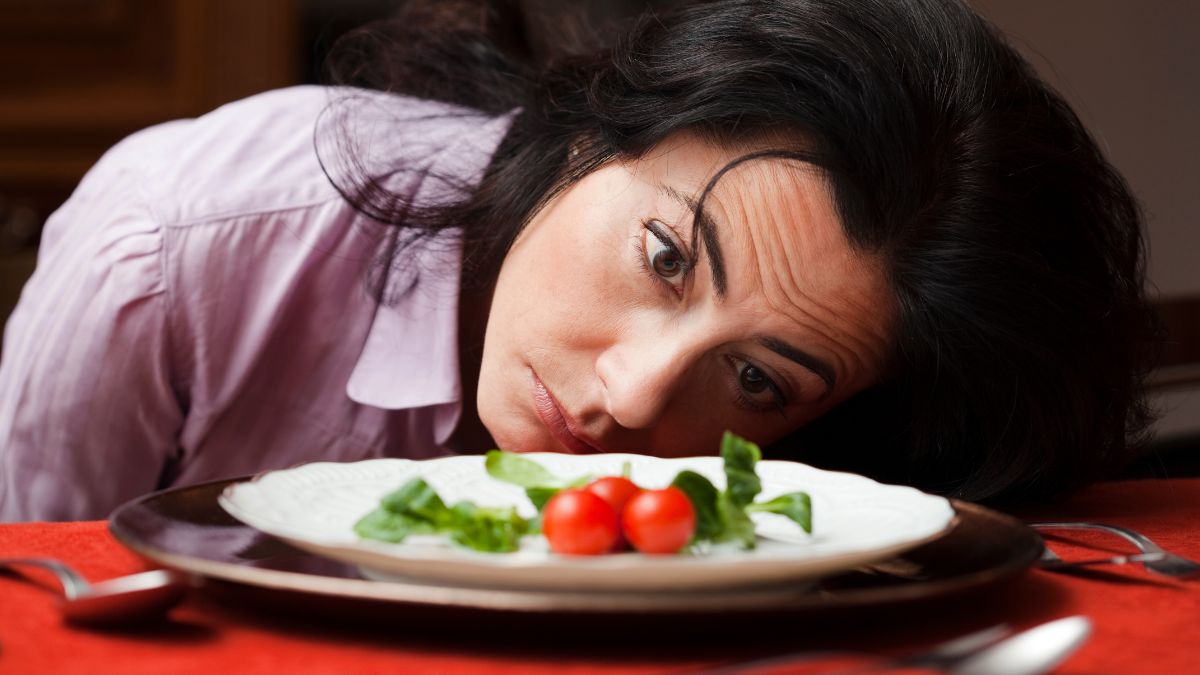
What Happened to Their Bodies
Some of the changes were what you’d expect:
- Significant weight loss (most lost 24% of their original weight)
- Muscle loss
- Reduced strength
- Lower body temperature
- Slower heart rate
- Extreme fatigue
Metabolic Adaptation
Their bodies didn’t just lose weight; they adapted pretty strongly.
Their resting metabolic rate dropped far beyond what weight loss alone would predict. Meaning the body didn’t just shrink; It started to defend itself.
Energy was held on to, movement became slower, and the body conserved calories. This was the body pretty much shifting to survival mode because food was so unpredictable and limited.
Psychological Changes
This part isn’t mentioned enough when we talk about nutrition or weight loss, but it’s just as important as what happens in the body physically.
As the restriction continued, the men changed psychologically.
They became:
- Obsessed with food: Constant thoughts about eating, menus, and recipes. Some collected cookbooks and spent hours reading about food instead of eating it.
- More anxious, depressed, and irritable: Their personality testing and self-reports6 showed increased depression, rising anxiety, low mood, emotional instability, and boredom.
- Socially withdrawn: Men who were previously outgoing became socially isolated and disengaged. Relationships were harmed and social gatherings completely dropped.
Their behaviors around food shifted, too.
They guarded it, ate really slowly, licked plates, cut food into tiny pieces, and even used condiments to make meals feel larger. Food became more than just fuel; it turned into something very emotional.
Many developed binge-like eating patterns during refeeding because semi-starvation had changed how their brains responded to food. Regularly eating less than the body needs changes reward, mood, and focus so strongly that it reshapes behavior and emotional regulation around food.
How Can We Use This Experiment to Understand the Impact of A Very Low-Calorie Diet on GLP-1s
Most women on GLP-1s are not trying to starve themselves, but because:
- Hunger drops dramatically
- Constant food thoughts disappear
- Fullness comes fast
- Meals are skipped without trying (they honestly forget to eat)
- Portions shrink on their own
This shows up as:
- 700–1,000 calories without intention
- Very low protein and carbs
- Long gaps between meals or skipped meals
- Minimal or no resistance training (not enough fuel means no energy)
- Weight loss that feels “easy”
It feels like the dream situation at first.
But physiologically, it can start to look a lot like controlled starvation, just without the usual red flags, because the medication is quieting those signals. And that’s where the problem starts.
What This Does Biologically
A. Lean mass loss speeds up
The body has a few places it can pull energy from: food coming in, stored fat, and muscle tissue, which it tries to protect, but will still break down when energy or protein is too low.
This tends to happen even faster in women who are mostly sedentary or new to training, because there isn’t much of a “signal” telling the body that this muscle is important enough to keep.
That matters because muscle is not just about strength or looking toned; it helps:
- Move sugar out of the blood and into cells
- Keep metabolism steady
- Respond to hormones like insulin and estrogen
- Protect against weight regain later
B. Metabolic adaptation still happens, even with GLP-1s
GLP-1 medications are very good at reducing overeating and improving how the body handles blood sugar.
But they don’t stop the body from responding to lower food intake. And when intake drops, the body responds in a few predictable ways:
- It starts needing fewer calories at rest
- Thyroid activity can slow down a bit
- You may move less throughout the day without really noticing (NEAT)
- And overall, the body becomes more focused on conserving energy
So even with GLP-1s, the body still learns that it needs to conserve when food intake is low. The medication masks hunger, but it doesn’t stop the body from adapting.
C. The brain still registers scarcity
Even if hunger feels calm, the brain is still keeping track of things like:
- How much food (energy) you’re actually eating
- How much weight is being lost, including fat and muscle
- How predictable or unpredictable nutrient intake is
Scarcity does not need to feel painful or dramatic for the brain to register it. You can feel “fine” and still be teaching your brain that food is not reliable.
And once the brain learns that, it usually shows up later as:
- Rebound hunger
- Food obsession after stopping GLP-1s
- Binge-like patterns
- Fear-based eating
Which is very similar to what the Minnesota Starvation Experiment showed us, just in a different context.
D. Hormonal systems shift toward protection
When calorie intake stays low for a while, the body starts adjusting its hormone signals to protect itself. Here’s what that looks like:
- Leptin drops as body fat and intake fall, which tells the brain energy is running low
- Ghrelin rises later, which is the body’s way of pushing hunger back up
- Thyroid hormones slow, pushing the body into a lower-energy state
- Reproductive hormones can shift, because fertility is not a priority when fuel is infrequent
- Cortisol can rise, keeping the body more alert and stressed
These shifts happen in both men and women, but in women, some of them have a tendency to show up more around hormones and cycle changes.
Why This Backfires Later
This is where it all connects to regain.
When someone stops GLP-1s, misses doses, or goes through a highly stressful period, they are often doing so with a body that now has:
- Less muscle
- A lower energy baseline
- A system trained to conserve
- A brain that has learned scarcity
- Hunger signals returning
So when appetite does come back, it’s coming back into a body that’s learned it can’t trust food to be consistent, and it starts trying to hold onto more of it.
This Is Not Unique to GLP-1s
The issue is not the medication itself. It’s letting eating less be the only thing holding everything together.
GLP-1s create a window where:
- Thoughts about food are less invasive
- Cravings are reduced
- Following a plan can feel easier
- Emotional eating is less reactive
That is a rare physiological moment to:
- Feed the body well
- Normalize eating rhythms
- Stabilize blood sugar
- Retrain how energy is regulated
- Train consistently
- Protect muscle
Not to lose as much as possible as fast as possible.
What Prevents Backfire
1. Eat enough overall, even when you’re not hungry
Especially:
- Protein, but carbs and unsaturated fats are important too
- Micronutrients (eat foods with lots of vitamins and minerals)
This is not about forcing yourself to eat; it’s just about paying attention so you don’t mistakenly undereat.
2. Prioritize muscle as non-negotiable
Resistance training is not about aesthetics here. It’s about keeping the kind of tissue that protects your metabolism while weight is changing.
Muscle helps:
- Preserve the tissue that actually uses energy
- Protect how your body handles blood sugar, since muscle holds and uses most of it
- Lower the risk of fat regain later
- Keep your baseline energy needs more stable
Muscle becomes a shield against regain.
3. Maintain meal structure even when appetite is low
Structure teaches the brain that food is predictable and that the body is not being deprived. That alone changes how future appetite, metabolism, and behavior respond.
This doesn’t mean you need strict rules around eating. It just means having some consistency in when and how you eat, even if portions are smaller than they used to be.
It also means taking an honest look at how little you might actually be eating.
I know for some women, the idea of tracking brings up a lot emotionally. But this is for a different reason, and it doesn’t mean counting every calorie.
Try keeping a simple food log for just a few days. It can be really eye-opening to see what’s actually there instead of guessing.
You might be surprised to find that you’re either regularly under-eating or right where your body needs you to be.
This Is Where Prescribing Practices Really Matter
GLP-1s were originally developed and studied for diabetes. Their use for weight management is newer.
Today, more people are getting them through quick telehealth visits or online programs with very little follow-up, nutrition guidance, and monitoring of things like muscle loss or overall nutrition intake.
Most prescribers are trained extremely well in medications, but not deeply in:
- Nutrition physiology
- Energy availability
- Eating behavior
- Muscle preservation
And even when nutrition is part of someone’s training, it can still be missed in real life.
This matters because when food intake drops too low or muscle loss isn’t being tracked, the body will still adapt, even if the scale looks “good” and hunger feels calm.
That’s why feeling cold shows up so often in this context. Not because the medication is wrong, but because the body is changing faster than it is being supported.
GLP-1s are powerful tools. They are extremely effective for diabetes and very promising for treating obesity. But weight loss alone should not be the only goal. Health during weight loss requires enough fuel, muscle preservation, appropriate dosing, education, and monitoring.
Resource
- The Scary Health Risk That Can Sneak Up on GLP-1 Users | Mary Brophy Marcus |January 19, 2026 ecd=WNL_trdalrt_pos1_260119_etid8039608&uac=538313EJ&impID=8039608 ↩︎
- https://myplate-prod.azureedge.us/sites/default/files/2023-04/800-calories-ages-12-23-months.pdf ↩︎
- https://nutritioncare.org/wp-content/uploads/2024/12/Nutritional-Considerations-Patients-on-Weight-Loss-Therapies.pdf ↩︎
- Physiology of weight regain: Lessons from the classic Minnesota Starvation Experiment on human body composition regulation First published: 05 February 2021
https://doi.org/10.1111/obr.13189Digital Object Identifier (DOI) ↩︎ - Starvation Experiment of Dr. Ancel Keys, 1944–1945 https://www.mnhs.org/mnopedia/search/index/event/starvation-experiment-dr-ancel-keys-1944-1945 ↩︎
- https://www.ncbi.nlm.nih.gov/books/NBK557525 ↩︎
Photo Credits
Woman Covered With Warm Blanket Sitting On Couch by Prostock-Studio
Dejected by Diet by Esolla from Getty Images Signature

Starting a fitness routine or healthy eating plan...




If you’re like many women on GLP-1 therapies, your...
GLP-1 medications have made weight loss feel...

Have you ever finished a full meal and still felt...